

Most people never see what happens to pigs before they reach their plates.
Not because the information isn’t out there but because no one has made it easy to look. That distance between farm and fork is comfortable and comfort has a way of quietly sustaining things that shouldn’t be sustained.
We wanted to close that distance. So, we made a film.
Our first documentary trailer on pig welfare is now live and it marks the beginning of something we’ve been working toward for a while. This isn’t a finished story. It’s the opening of one. A journey to shine light on the realities that most people never encounter, raise honest awareness and most importantly inspire practical solutions at every level in communities, on farms and in the policy rooms where decisions get made.
Change doesn’t start with legislation or formal frameworks as important as those things are. It starts with people seeing something they hadn’t seen before and deciding they can’t unsee it.
That’s what this trailer is for
Watch it. Share it. And stay with us this is only the beginning.

Uganda Has Nearly 10 Million Pigs. Almost No One Is Talking About Their Welfare
Entebbe, Wakiso District
There’s a particular kind of neglect that isn’t loud or obvious. It doesn’t announce itself. It just shows up quietly in the absence of data, the silence in policy rooms, and the blank spaces where regulations should be.
That’s what we found when we turned our attention to pigs in Uganda.
Starting With an Honest Question
In March 2025, we began a strategic assessment of animal welfare gaps in Uganda not to confirm what we already knew but to genuinely ask: which animals are being left behind? Which species have slipped through the cracks of policy, research and public attention?
Fish and poultry welfare are growing areas of focus and rightly so. But as we worked through the landscape, one group kept standing out for all the wrong reasons: pigs.
Uganda is now home to nearly 10 million pigs. That number has grown significantly over the last decade, driven by rising demand, expanding smallholder operations and the pig’s reputation as a relatively low-cost, high-return animal. And yet, despite this growth, there is almost no systematic attention to how these animals are kept, transported, slaughtered, or protected.
No meaningful data. Limited regulation. Minimal enforcement. Pigs have become one of the most economically significant and most welfare-neglected farmed animals in the country.
Why This Matters More Than It Might Seem
We know that welfare conversations can sometimes feel distant from the urgency of other issues food security, livelihoods, public health. But these things are connected, not competing.
Animals raised in poor conditions are more susceptible to disease. Stressful handling and transport affect meat quality. Slaughter practices that ignore basic welfare standards carry real risks that ripple outward into food systems and communities. And when there’s no data, no standards and no enforcement, everyone farmers, consumers and the animals themselves absorb the consequences.
The gap in pig welfare isn’t just an animal welfare problem. It’s a governance problem, a food system problem and a public health problem.
What We're Doing About It
In April 2025, we launched The Pig Welfare Initiative to address this gap directly.
The initiative focuses on key welfare indicators: how pigs are housed, fed, transported and slaughtered and what access they have to basic veterinary care. We’re conducting field research, documentation and investigative reporting building the kind of credible, locally grounded evidence that Uganda’s policymakers and regulators actually need to act.
We’re not approaching this as outsiders with preconceived conclusions. We’re approaching it as researchers who believe that good policy has to be rooted in real conditions on the ground.
Our work is aimed at three concrete outcomes:
- Developing and strengthening animal welfare standards
filling the regulatory vacuum with evidence-based recommendations that are practical and enforceable. - Improving implementation of existing regulations
because the problem isn’t always the absence of rules. Sometimes it’s the absence of the will, capacity, or systems to apply them. - Integrating animal welfare into broader policy frameworks
agriculture, public health, food systems. Animal welfare shouldn’t be a siloed conversation. It belongs in the rooms where the bigger decisions are being made.
This Is About More Than Pigs
We want to say that plainly, because it’s important.
The Pig Welfare Initiative is a starting point. Our focus on pigs isn’t because other animals matter less, it’s because pigs represent a clear, specific, and largely unaddressed gap where credible intervention is possible right now. And we believe that building an evidence-based case for pig welfare reform can create a policy entry point for broader farmed animal welfare reform in Uganda.
Systemic change doesn’t happen all at once. It requires data that holds up to scrutiny. It requires institutions that are willing and equipped to act. And it requires political will which, in our experience, tends to follow when the evidence is compelling and the case is clearly made.
That’s what we’re building. One initiative at a time.
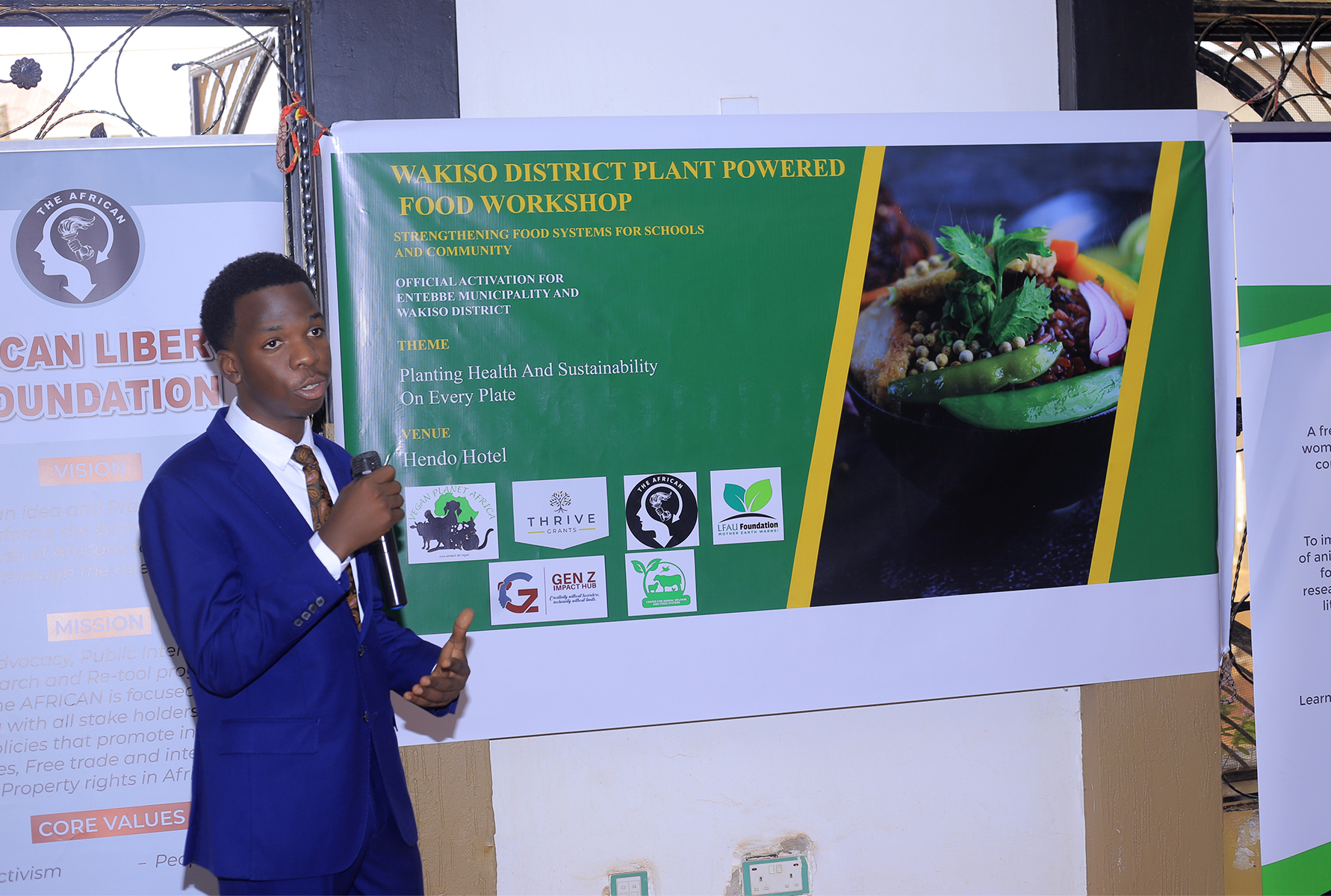
Wakiso Plant Powered Food Workshop: Building Sustainable Food Systems for the Future
Entebbe, Wakiso District
This diverse representation created an enriching platform for training, discussion and forward-looking strategies toward building a sustainable plant-powered system for greater Wakiso.
The African Institute for Animal Welfare, through its community-driven initiatives successfully hosted the Wakiso Plant Powered Workshop bringing together over 60 participants from different policy and community institutions across Wakiso District and Entebbe Municipality.
Attendees included representatives from the Head Teachers Associations Committee, district councilors the food science research team from Nkumba University, Nkumba University guild leadership, the Community Development Officer’s office and the Mayor’s office of Entebbe Municipality.
Key Highlights of the Workshop
- Project Sustainability Tools launched The workshop marked the premier launch of two milestone resources: the first Plant-Powered Cookbook inspired by Ugandan food culture and a Smart Agriculture Manual designed to support school gardens, women’s empowerment projects, community gardens, and small urban farming.
- Commitments from the Education Sector The Head Teachers Associations Committee, representing 10 schools with over 843 students, committed to:
- Prioritize mineral-rich plant foods in their schools.
- Introduce the Plant-Powered Cookbook in their libraries.
- Integrate traditional plant-based recipes into the curriculum for food and nutrition students.
- Collaborative Partnerships More than four organizations joined hands in shaping a new narrative for healthy food culture in Uganda. Youth politicians also participated, aligning their manifestos with policies for affordable, mineral-rich foods that improve the quality of life for their constituencies.
- Youth Engagement for Health and Rehabilitation For the first time, the workshop partnered with the Entebbe Ghetto Youth Association — an organized youth group of former drug addicts now using plant-powered foods as a tool for rehabilitation and health restoration. Represented by their president and secretary, they shared their journey and agreed on continuous engagement in initiatives promoting better health and sustainable food practices.
Why This Matters
Creating a sustainable plant-powered food system goes beyond inspiring students, it requires influencing decision-makers who shape school menus, regulators who safeguard food safety and communities that sustain everyday food practices.
This workshop was a clear step toward systemic change ensuring that plant-based food solutions are not only accessible but also culturally relevant, health-focused and community-driven.